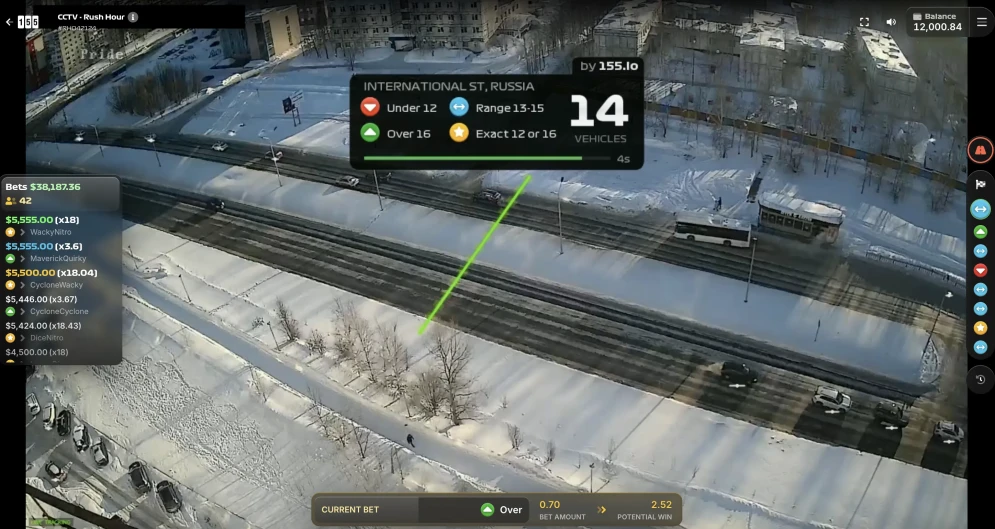
CCTV Rush Hour runs at over 60 rounds per hour. Results keep coming, cameras alternate between Tokyo, London, Sydney, and other cities. At this pace, a player without a method ends up betting erratically. The strategies below do not turn the house edge into a player advantage. Claiming otherwise would be dishonest. They organize the approach, reduce avoidable mistakes, and extend sessions.
Before reading this guide, an essential reminder: the casino holds a mathematical edge of 6.5% to 8.5% on every bet. This means that out of 1,000 EUR wagered in total, between 65 and 85 EUR go to the casino over the long term. No observation technique, no betting system, no camera choice changes this reality.
With that said, here is how to approach CCTV Rush Hour with a minimum of structure.
Understand the Mechanics Before Betting
The game relies on a simple principle: a surveillance camera films a real intersection, somewhere in the world. The AI from 155.io detects and counts every vehicle (or pedestrian, depending on the camera) that crosses the detection zone during 55 seconds. The player bets on the result of that count.
Three bet types are available:
- Pick Winner - Under, Over, or Range. The player predicts whether the number of detected vehicles will be below the threshold, above it, or within the central bracket. RTP 93.5%.
- Any Order - Multiple predictions within a single round, regardless of order. Forecast and Reverse Forecast are variants of this mode. RTP 92.5%.
- Exact Order - The player announces the precise number of vehicles. Payout x18, RTP 91.5%.
The reference threshold (the Under/Over line) varies based on the active camera and local time. The system adjusts these parameters automatically. A player who jumps in without watching the camera risks betting blindly on a threshold they do not understand.
Each round lasts approximately 55 seconds. The bet placement window precedes the round. Once the countdown starts, the bet is locked. Dolby Millicast streaming ensures sub-second latency between the real feed and what the player sees on screen.
Understanding these mechanics is the first step. Betting without knowing how the threshold is calibrated, how the AI detects vehicles, or how long a round lasts is like playing a game whose rules you have not read.
Conservative Strategy: Pick Winner Only
Pick Winner is the most accessible bet in CCTV Rush Hour. Three options: Under, Over, Range. The player does not need to predict an exact number, just a trend.
The 93.5% RTP is the highest in the game. In simple terms, over a large volume of rounds, the system returns 93.5 cents per euro wagered. The house edge drops to 6.5%, the lowest of all options.
The conservative approach means playing Pick Winner exclusively, never switching to Any Order or Exact Order. The payout stays modest (about x3 for Under, x3.6 for Over), but the win frequency makes up for it.
How to apply this approach
- Fixed bet at 1% of session bankroll - For a 50 EUR budget, each bet is 0.50 EUR. No variation, no doubling after a loss.
- Bet choice after observation - Watch 3-5 rounds to evaluate current traffic volume, then bet Under or Over based on the perceived trend.
- Limited session duration - 20 minutes maximum. Beyond that, focus drops and bets become mechanical.
- No mode switching during a session - The temptation to switch to Exact Order after a winning streak is real. The conservative strategy forbids it.
This approach does not generate spectacular wins. An x3 on 0.50 EUR is 1.50 EUR. But over 20 rounds with a 40-45% hit rate, the balance shifts in small, steady increments. Variance stays low. Sessions last longer. The bankroll survives.
The Pick Winner only approach suits players who want to discover the game without burning their budget in three rounds. It is also the recommended approach in demo mode, to build a foundation before switching to real money.
Observation Strategy: Analyze the Feed Before Betting
CCTV Rush Hour has a feature that crash games and slots do not: the player can watch the live feed before betting. The traffic is visible. Vehicles pass by. The AI counts. The player observes.
The idea behind this strategy is to maximize this observation window. Not to "beat" the system - the thresholds adjust automatically - but to spot temporary patterns in the traffic flow.
Watch 3 to 5 rounds without betting
When opening a session, do not bet during the first 3 to 5 rounds. Watch the camera. Mentally note the number of vehicles the AI detects each round. This free observation phase provides a snapshot of the active camera's rhythm.
During these observation rounds, ask three questions:
- Does the traffic volume seem consistent from one round to the next, or is it erratic?
- Is the Under/Over threshold calibrated tightly (little margin) or loosely (lots of margin)?
- What is the local time in the city being filmed by the camera?
The time zone factor
CCTV Rush Hour cameras are spread across multiple time zones. The camera's local time radically changes the traffic volume.
A camera in Tokyo at 8am captures rush hour. Dozens of vehicles per round. The Under/Over threshold is calibrated accordingly, but the flow is dense and predictable in its density.
The same camera at 3am captures a trickle of vehicles. A few taxis, a delivery truck. The count varies from 0 to 5. The threshold is low, but a single unexpected motorcycle can flip the result.
Groningen cameras in the evening, Sydney cameras in the morning, Bangkok cameras in the middle of the afternoon - each city/time combination creates a different context. A player who ignores the time zone is throwing away free information.
Rush hour vs off-peak hours
Rush hours (7-9am and 5-7pm local time) produce dense and relatively stable traffic. The number of vehicles per round varies little. This is a favorable context for Pick Winner, because the Under or Over trend is easier to read.
Off-peak hours (10pm-6am local time) produce thin and unpredictable traffic. A single extra or missing vehicle can flip the result. This is a higher-variance context, where surprises are frequent.
Camera placement matters too. A six-lane intersection does not capture the same flow as a one-way pedestrian crossing. The type of road, the number of lanes, the presence of traffic lights - everything influences the AI count.
This observation strategy does not change the house edge. It structures the thinking before each bet.
Intermediate Strategy: Any Order and Its Variants
Any Order steps it up from Pick Winner. The player no longer just picks Under, Over, or Range: they predict multiple outcomes within a single round, regardless of order.
The RTP drops to 92.5%, but the payouts climb between x6 and x9. It is a compromise between Pick Winner's safety and Exact Order's boldness.
When to use Any Order
- After an observation phase of 5+ rounds - The player has identified a pattern in the flow and wants to capitalize on it with a higher payout than simple Under/Over.
- On cameras with steady traffic - Busy intersections during rush hour produce relatively stable counts. Any Order works better in this context.
- When the bankroll allows it - The bet stays at 1% of the session budget, but the win frequency is lower than Pick Winner. The bankroll needs to be large enough to absorb lost rounds.
Forecast and Reverse Forecast
These are variants of Any Order mode. Forecast requires predicting two results in order. Reverse Forecast covers both possible orders, for a slightly reduced payout.
These modes target players who have spent time watching the feeds and want to go beyond simple Under/Over. The required precision is greater, and so is the risk.
A player watching the Shibuya camera at 8am knows the flow will be dense. A Forecast on two consecutive brackets (for example, bracket 12-15 then bracket 10-13) is a structured bet, not a coin flip. But the result remains uncertain - the AI might detect a scooter that the human eye missed.
Putting it into practice
The Any Order bet size stays proportional to the bankroll. The 1% rule applies the same way as in Pick Winner. The only difference is that win frequency drops while individual win amounts increase.
A player on a 100 EUR budget bets 1 EUR per round in Any Order. Over 20 rounds, they might win 5 to 7. But each win pays x6 to x9, meaning 6 to 9 EUR. The balance between wins and losses depends heavily on the session. Variance is higher than Pick Winner.
Aggressive Strategy: Exact Order and the x18 Payout
Exact Order is the most ambitious bet in CCTV Rush Hour. The player calls an exact number of vehicles detected during the 55-second round. If the AI count lands exactly on that number, the payout is x18.
The RTP drops to 91.5%. The house edge reaches 8.5%. The casino margin is highest on this bet type. That is the price of the high multiplier.
Why try Exact Order
The x18 payout turns a modest bet into a notable win. 5 EUR becomes 90 EUR. 10 EUR becomes 180 EUR. 20 EUR becomes 360 EUR. A single successful round can cover an entire session of losses.
That is the scenario that draws players in. But it needs context: the probability of landing on the exact number is low. On a high-density traffic camera, the number of vehicles detected per round varies within a range of 5 to 15 units. Guessing the exact number within that range is partly down to chance.
How to prepare an Exact Order
- Watch at least 5 full rounds - Note the AI count each round. Identify the average and the spread (even informally).
- Stay on the same camera - Switching cameras between the observation rounds and the betting round destroys the benchmarks you built.
- Bet the observed median number - If the last 5 rounds gave 11, 13, 12, 14, 12, then 12 seems most likely. It is not a certainty, it is an estimate.
- Limit the attempts - 1 to 2 Exact Orders per session at most. The rest in Pick Winner or Any Order to protect the bankroll.
Tricast: the extreme version
Tricast takes the concept even further. Three exact predictions in a row. The payouts become substantial, but the probability of success drops to a level where chance dominates completely.
Tricast is a recreational bet, not a profitability tool. A player who puts 0.50 EUR on a Tricast from time to time adds some excitement to their session without endangering their bankroll. Betting 20 EUR on a Tricast is a different story.
Exact Order (and even more so Tricast) demands strict discipline. The temptation to repeat attempts after a miss is strong. The x18 gleams in the player's mind. But each failed attempt chips away at the bankroll at a rapid rate.
Bankroll Management: The Only Real Protection
Of all the "strategies" listed on this page, bankroll management is the only one with a concrete, measurable impact. It does not change the probabilities. It protects the player from themselves.
The 1% rule
Never wager more than 1% of the session budget per round. 50 EUR budget = 0.50 EUR bet. 200 EUR budget = 2 EUR bet.
With this rule, you would need to lose 100 rounds in a row to drain the bankroll. That is statistically very unlikely, even with an 8.5% house edge. The 1% rule slows the erosion of the bankroll and extends the session.
Fixed session budget
Before launching the first round, set a specific budget. 20 EUR. 50 EUR. 100 EUR. This amount is the absolute maximum for the session. Once lost, the session is over. No reloading, no "one last round to make it back."
The session budget should be money the player is prepared to lose entirely. If losing 50 EUR causes a real financial problem, the budget is too high.
Stop-loss
The stop-loss is a loss threshold that triggers the end of the session. For example: stop after losing 50% of the initial budget. 100 EUR budget, stop-loss at 50 EUR. As soon as the balance drops to 50 EUR, the session stops.
The stop-loss prevents sessions from spiraling. A player who loses 30% of their budget in 5 minutes risks switching to "chase mode" - bigger bets, riskier choices, a downward spiral.
Take-profit
The take-profit works in reverse. It is a gain threshold that triggers a cashout. For example: cash out after doubling the initial budget. 50 EUR budget, take-profit at 100 EUR. As soon as the balance reaches 100 EUR, the player cashes out and leaves the session.
Without a take-profit, winnings go back into the next bets. A player who climbs to +80% then drops back to -20% did not win 80%. They lost 20%. The take-profit locks in gains before they evaporate.
Summary in numbers
- Bet per round - 1% of session budget
- Stop-loss - 50% of initial budget (adjust based on risk tolerance)
- Take-profit - +50% to +100% of initial budget (set before the session)
- Maximum duration - 20 minutes per session, mandatory break in between
- No reloading - The session budget is set once, before the first round
The Most Common Mistakes to Avoid
Players who blow through their bankroll in minutes almost always make the same mistakes. By listing them, the goal is not to moralize but to identify behaviors that accelerate losses.
Chasing losses
The classic. The player loses 3 rounds in a row. Instead of keeping the bet at 1% of the bankroll, they double or triple to "catch up." The next round is lost too. The bet goes up again. In 5 rounds, 40% of the budget is gone.
The martingale (doubling after each loss) is mathematically doomed to fail on a game with a 6.5-8.5% house edge. The bet cap (500 EUR) makes it even less viable.
Ignoring the camera's time zone
A player who bets Over on a camera filming a city at 3am local time is exposing themselves to a very low count. The threshold adjusts, sure, but the flow remains unpredictable during off-peak hours. Checking the camera's local time takes 5 seconds and can prevent a poorly calibrated bet.
Betting without observing
Entering a round without watching the live feed is betting blind. The displayed Under/Over threshold does not tell the whole story. Traffic rhythm, flow density, alternating traffic lights - these elements are visible on screen. Not looking at them means giving up free information.
No defined budget
Playing "until the money runs out" without a fixed budget turns every session into financial Russian roulette. The player does not know when to stop. Winnings go back into bets. Losses pile up. A session budget is a framework, not a constraint.
Switching strategies mid-session
Starting with Pick Winner, moving to Exact Order after a win, going back to Any Order after a loss. This back-and-forth between modes disrupts bankroll management. The 1% bet calculated for Pick Winner (low variance) does not match the rhythm of Exact Order (high variance).
Playing too long
At 60+ rounds per hour, a 2-hour session means 120+ rounds. At 1 EUR per round, that is 120 EUR wagered. With an average house edge of 7%, the theoretical loss reaches 8.40 EUR. The longer the session, the closer the theoretical loss aligns with actual loss. Short sessions (15-20 minutes) limit exposure to the house edge.
What No Strategy Can Change
This section is the most important on the page. Everything above - observation, bankroll management, bet type selection - does not alter the following mathematical fact:
The house edge of CCTV Rush Hour is 6.5% to 8.5% depending on the bet type.
Concretely:
- Pick Winner (RTP 93.5%) - Over 1,000 EUR wagered, the casino keeps 65 EUR on average in the long run.
- Any Order (RTP 92.5%) - Over 1,000 EUR wagered, the casino keeps 75 EUR on average in the long run.
- Exact Order (RTP 91.5%) - Over 1,000 EUR wagered, the casino keeps 85 EUR on average in the long run.
These numbers are statistical averages. Over a short session, a player can win 200 EUR or lose 50 EUR. Variance plays fully on small samples. But over hundreds or thousands of rounds, the house edge asserts itself with mathematical regularity.
No traffic observation, no time zone analysis, no bankroll rule can turn a 93.5% RTP into 100%+. The game is designed so that the casino wins over the long term. That is the business model of every gambling game.
The real role of a strategy
If strategy does not beat the odds, what is it for? Three things:
- Structuring sessions - Avoiding impulsive bets, compulsive reloads, loss spirals.
- Slowing bankroll erosion - The 1% rule and the stop-loss extend the lifespan of the session budget.
- Keeping the game in the entertainment zone - A player who plays methodically, with a set budget and clear limits, stays in control of their practice.
CCTV Rush Hour is an entertainment game based on real traffic prediction. The enjoyment comes from watching the feed, the tension of the countdown, the result dictated by the real world. Not from the certainty of winning - that certainty does not exist.
Responsible gambling - Key guidelines
- Set a budget BEFORE playing - Never deposit more than you can afford to lose without impacting your daily life.
- Use the casino's tools - Deposit caps, loss limits, session timer, self-exclusion. Set them up beforehand.
- Gambling is not a source of income - It is entertainment that costs money over the long term, like going to the cinema or a concert.
- Take regular breaks - 15-20 minutes of play, then a break. The fast pace of CCTV Rush Hour (60+ rounds/hour) makes breaks even more necessary.
Need help? GambleAware - www.BeGambleAware.org | GamCare - 0808 802 0133
Apply These Approaches on CCTV Rush Hour
Demo mode is the ideal ground to test these approaches without financial risk. Virtual credits, the same live cameras, the same mechanics. When the foundations are in place, the switch to real money comes with a framework already built.
The house edge of 6.5-8.5% remains active in real mode. Gamble responsibly.